Five mistakes that keep your pages out of AI answers
New research on how ChatGPT, Gemini and Claude choose their sources, and the five mistakes it exposes on large websites.
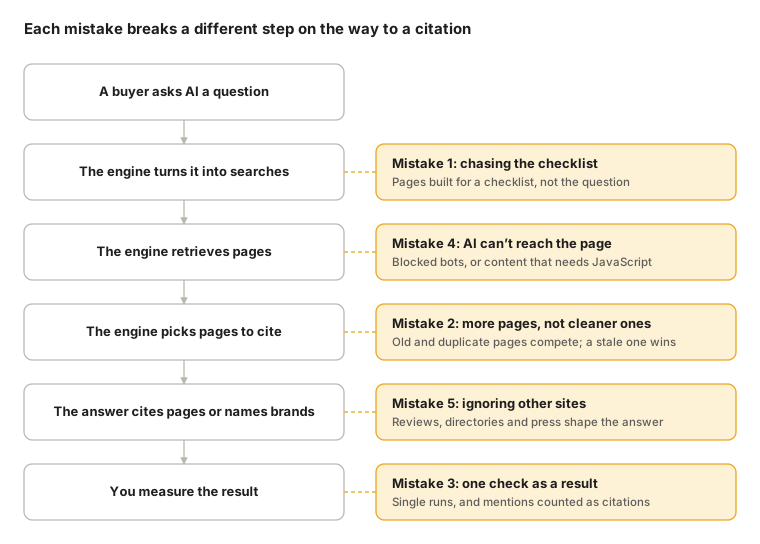
Most teams now know ChatGPT, Gemini and Claude answer questions about their market. Fewer know what decides which pages those answers cite. Two large studies published in the past month give a clearer picture, and it doesn't match the advice most teams follow. Here are the five mistakes we see most often on large websites, and what to do instead.
1. Chasing the AEO checklist
AEO (answer engine optimisation) is the work of getting your pages used and cited in AI answers. Most AEO tools score pages on a checklist: FAQ blocks, schema markup, summary boxes, page speed, llms.txt. Teams work through it page by page.
The new research suggests that checklist explains very little. When researchers compared pages on the same website, FAQ blocks, structured data and summary boxes stopped predicting citations. They only looked effective when comparing different websites, because strong websites tend to use them. What did hold up within a site: pages whose titles and paragraphs match the questions buyers actually ask.
Instead: pick the questions your buyers ask AI, and check that one clear page answers each of them in plain words.
2. Publishing more instead of cleaning up
The usual response to weak AI visibility is more content. On a site with hundreds of pages, that often makes things worse. Old posts, near-duplicate guides and pages with outdated facts all compete to answer the same question. The AI engine may pick the stale one, or none.
We saw this in Field Notes #1: all five sites we checked still published pages about 2024 or earlier, and AI crawlers read them like any other page.
One professional services company we work with has about 1,100 pages. What its team valued most wasn't a score. It was a clear decision for each page: keep, update, merge or remove, with the reason.
Instead: before writing anything new, decide which existing page should own each question. Merge or retire the rest, and fix outdated claims on the pages you keep.
3. Treating one check as a result
Ask ChatGPT the same question twice and you can get different sources. Teams still run one check after a change and report it as a win or a failure. Many also count every brand mention as success, even when the answer cites someone else's page.
Mentions and citations are different things. AI models name brands they already know, sometimes without citing any page at all. A page change can't move that, so counting it hides whether your fix worked.
Instead: re-run the same questions several times, compare against a page you didn't change, and track citations of the page you fixed separately from mentions.
4. Never checking whether AI can reach the page
An AI engine can only cite a page its own search retrieved. In one study, which pages that search retrieved explained far more about citations than anything on the page itself: 32% of the variation, against 2.8%. Retrieval comes first.
Yet few teams check whether AI crawlers reach their key pages at all. Blocked bots, content that only loads with JavaScript, and default bot rules on a CDN can quietly remove a page from the running.
Instead: check your robots.txt and CDN bot settings, and confirm your most important pages render without JavaScript. Your server or CDN logs show which AI crawlers actually visit.
5. Ignoring what other sites say about you
AI answers draw heavily on third-party pages: reviews, directories, comparison articles, forums and press. A separate study found citations concentrate on a few domains per platform. It also showed how easily some of those sources can be gamed: most platforms tested cited a made-up concept within a week of it being posted.
So a citation count alone says little about trust. And fixing your own site is only part of the picture.
Instead: list the third-party sources AI cites for your key questions, and check that what they say about you is accurate and current. Don't try to game them; it is easy to detect and hard to undo.
What to fix this week
You don't need a new tool to start. Pick five buyer questions and work through them:
- Ask ChatGPT, Gemini and Claude each question three times and note which pages they cite
- For each question, name the one page on your site that should answer it
- Find older pages covering the same question, and decide whether to merge, update or remove them
- Check that AI crawlers can reach those pages and see the content without JavaScript
- Make one change, then re-ask the same questions over the next two weeks
The research is clear on one point: nobody can promise that a specific edit will raise citations. What you can do is fix the right pages and measure honestly. That's the loop we're building Ocli around.
Sources
- Chen & Koudas (10 Oct 2026), What Drives AI Citations? Content, Retrieval and Model Knowledge in GEO, arXiv preprint
- Moore & Dunne (28 Sep 2026), What Drives Citations in Production Large Language Models?, arXiv preprint
- Liu et al. (8 Oct 2026), From Public Posts to AI-Search Citations: Measuring the Fragility of AI Search, arXiv preprint
All three are preprints and observational or controlled studies. They show patterns, not guaranteed results for any one site.